
 |


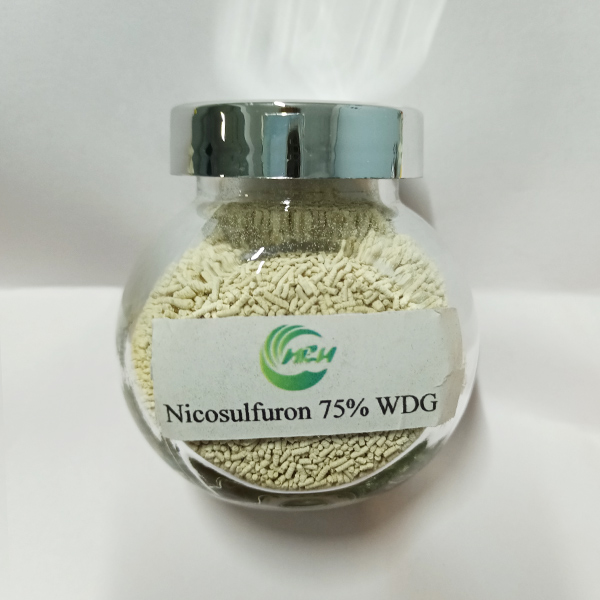
WDG
HRH
HRH0016
| Quantity: | |
|---|---|
Chemical Name: 2-(4,6-Dimethoxypyrimidin-2-ylcarbamoylsulfamoyl)-N,N-dimethylnicotinamide
Molecular Formula: C₁₅H₁₈N₆O₆S
CAS No.: 111991-09-4
Active Ingredient Content: 75% (w/w)
Formulation: Water-Dispersible Granules (WDG)
Appearance: Colorless crystals or off-white powder
Sulfonylurea systemic herbicide, belonging to Acetolactate Synthase (ALS) inhibitors
Inhibits the ALS enzyme of weeds, blocks the synthesis of branched-chain amino acids (valine, leucine, isoleucine), leading to weed growth stagnation and death
Absorbed by weed stems, leaves and roots, and rapidly translocated to meristems through xylem and phloem
Rapidly disperses in water to form a stable suspension, combining the characteristics of wettable powder and emulsion
Low dust, safe for operators
Good fluidity and accurate metering
High storage stability
Maize (especially dent and flint maize varieties)
Sorghum and other gramineous crops
Annual gramineous weeds: Barnyardgrass, crabgrass, green foxtail, etc.
Some broadleaf weeds: Redroot pigweed, eclipta, etc.
Also has a certain inhibitory effect on some perennial weeds (such as bermudagrass)
Post-emergence in maize fields: 35~70 g(a.i.)/hm² [approximately 2.3~4.7 g(a.i.) per mu]
75% WDG formulation: Approximately 3~5 grams per mu, mixed with 30~45 liters of water
Maize at 3~5-leaf stage, weeds at 2~5-leaf stage
Choose windless weather with suitable temperature (20~30℃) and high humidity
Avoid high temperature (>32℃), drought and rainy days
First mix the herbicide with a small amount of water to form a paste, then add water to dilute to the required concentration
Uniform foliar spray to ensure full coverage of weeds
Use low dosage when weeds are small and water conditions are good; use high dosage when weeds are large and under drought conditions
Sensitivity of different maize varieties: Dent maize > Flint maize > Popcorn > Sweet maize
Sweet maize and waxy maize are highly sensitive to nicosulfuron, prone to phytotoxicity, and are generally not recommended
Maize may experience temporary chlorosis after application, which can generally recover within 1~2 weeks
Avoid mixing with organophosphorus and carbamate insecticides; if necessary, an interval of more than 7 days should be maintained
Keep the field moist before and after application to improve efficacy
Adding an appropriate amount of special adjuvants (such as methylated vegetable oil) during mixing can improve efficacy
Long residual period in soil: approximately 70 days in sandy loam and 52 days in clay loam
Pay attention to the interval period when planting sensitive subsequent crops (such as tobacco)
Low toxicity to aquatic organisms, but still avoid polluting water sources
复配组合 | 优势 | 推荐用量 |
烟嘧磺隆+莠去津 | 扩大杀草谱,兼具封闭和茎叶处理效果 | 每亩30%烟嘧悬浮剂50ml+38%莠去津100ml |
烟嘧磺隆+氯吡嘧磺隆 | 提高对阔叶杂草防效,增产10%以上 | 40g/L烟嘧45~52.5g a.i./hm²+75%氯吡嘧15g a.i./hm² |
烟嘧磺隆+硝磺草酮 | 速效性好,对禾本科和阔叶杂草均高效 | 每亩10%硝磺60ml+75%烟嘧3~5g |
Tank Mix Combinations | Advantages | Recommended Dosage |
Nicosulfuron + Atrazine | Expand weed control spectrum, with both pre-emergence and post-emergence effects | 50ml of 30% nicosulfuron suspension + 100ml of 38% atrazine per mu |
Nicosulfuron + Halosulfuron-methyl | Improve control effect on broadleaf weeds, increase yield by more than 10% | 45~52.5g a.i./hm² of 40g/L nicosulfuron + 15g a.i./hm² of 75% halosulfuron-methyl |
Nicosulfuron + Mesotrione | Good quick-acting effect, highly effective against both gramineous and broadleaf weeds | 60ml of 10% mesotrione + 3~5g of 75% nicosulfuron per mu |
Nicosulfuron 75% WDG is a high-efficiency sulfonylurea herbicide, especially suitable for post-emergence weed control in maize fields, acting by inhibiting the ALS enzyme of weeds. Attention should be paid to crop safety during application, master the optimal application period and dosage, and select appropriate tank mix formulations according to weed conditions to improve control effect.