
 |


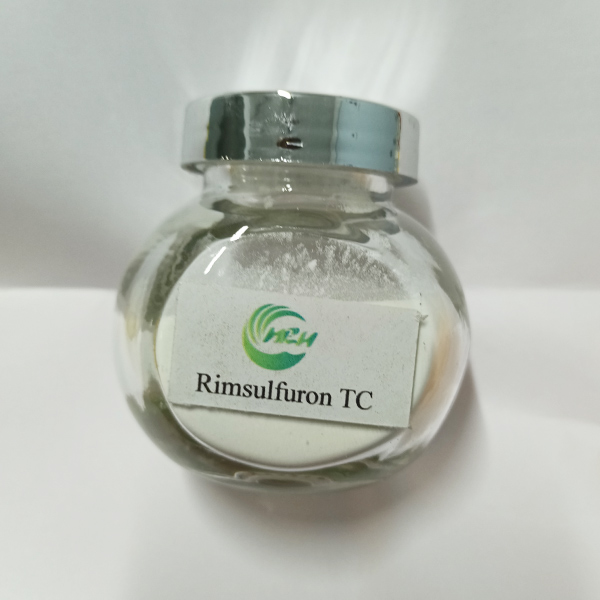
TC
HRH
HRH0014
| Quantity: | |
|---|---|
Chinese Name: 砜嘧磺隆
English Name: Rimsulfuron
CAS No.: 122931-48-0
Molecular Formula: C₁₄H₁₇N₅O₇S₂
Molecular Weight: 431.44
Chemical Name: 1-(4,6-Dimethoxypyrimidin-2-yl)-3-(3-ethylsulfonyl-2-pyridinesulfonyl)urea
Trade Names: Titus, Baocheng
Formulation: TC (Technical Concentrate)
Active Ingredient Content: 95-99% (standard content ≥95%)
Appearance: White crystalline solid
Melting Point: 176~178℃
Vapor Pressure: 1.5×10⁻³ mPa (25℃)
Density: 1.503 g/cm³
Solubility: Solubility in water <10 mg/L (25℃), 7.3 g/L in buffer solution (pH7)
Partition Coefficient: Kow=0.034 (pH7, 25℃), strong hydrophilicity
Stability: Most stable in neutral soil, degrades rapidly under acidic and alkaline conditions
Soil Half-Life: 1.7~4.3 days, low environmental residue
Inhibits Acetolactate Synthase (ALS), blocking the synthesis of branched-chain amino acids (valine, isoleucine)
Inhibits cell division and plant growth, causing weeds to stop growing, chlorosis, necrosis and eventually die
Selective: Crops such as corn can rapidly metabolize it into inactive substances (half-life only 6 hours), while weeds metabolize it slowly, thereby protecting crops
Corn: Controls annual and perennial gramineous weeds and broad-leaved weeds
Potato, Tobacco: Pre-emergence or post-emergence weeding
Tomato, Pepper, Sweet Potato: Directed spraying for weed control
Fruit Trees (Grape, Apple, etc.): One of the few sulfonylurea herbicides usable for fruit trees
Gramineous Weeds: Avena fatua, Echinochloa crusgalli, Setaria viridis, Digitaria sanguinalis, Lolium multiflorum, etc.
Broad-leaved Weeds: Amaranthus retroflexus, Galium aparine, Papaver rhoeas, Stellaria media, Abutilon theophrasti, etc.
Perennial Weeds: Cyperus rotundus (Nutgrass), Cirsium arvense, Salsola kali, Rumex crispus, etc.
Special Control Effect: Special effect on Cyperus rotundus and Acalypha australis
Corn Fields: Apply at the 2-4 leaf stage of spring corn or 2-4 leaf stage of weeds
Recommended Dosage: 5~15 g(a.i.)/hm² (0.33~1.0 g per mu)
Application Method: Foliar spraying, need to add 0.1~0.25% non-ionic surfactant to improve efficacy
Note: Applying after corn exceeds the 4-leaf stage is prone to phytotoxicity (dwarfing, heart leaf curling), which can recover in 10~15 days
Toxicity: Low to slightly toxic, LD₅₀ >5 g/kg (oral, rat), LD₅₀ >2 g/kg (dermal, rat)
Effect on Skin: Non-irritating, slightly irritating to eyes
Effect on Environment: Low toxicity to birds, fish and bees, LC₅₀ >1 g/kg for earthworms
Residue: Degrades rapidly in soil, safe for subsequent crops, low risk of groundwater contamination
China Agricultural Industry Standard: NY/T 3580-2020 "Rimsulfuron Technical Concentrate"
Main Indicators: Active ingredient content ≥95.0%, moisture ≤0.5%, acidity (calculated as H₂SO₄) ≤0.3%
Chinese Name: 砜嘧磺隆
English Name: Rimsulfuron
CAS No.: 122931-48-0
Molecular Formula: C₁₄H₁₇N₅O₇S₂
Molecular Weight: 431.44
Chemical Name: 1-(4,6-Dimethoxypyrimidin-2-yl)-3-(3-ethylsulfonyl-2-pyridinesulfonyl)urea
Trade Names: Titus, Baocheng
Formulation: TC (Technical Concentrate)
Active Ingredient Content: 95-99% (standard content ≥95%)
Appearance: White crystalline solid
Melting Point: 176~178℃
Vapor Pressure: 1.5×10⁻³ mPa (25℃)
Density: 1.503 g/cm³
Solubility: Solubility in water <10 mg/L (25℃), 7.3 g/L in buffer solution (pH7)
Partition Coefficient: Kow=0.034 (pH7, 25℃), strong hydrophilicity
Stability: Most stable in neutral soil, degrades rapidly under acidic and alkaline conditions
Soil Half-Life: 1.7~4.3 days, low environmental residue
Inhibits Acetolactate Synthase (ALS), blocking the synthesis of branched-chain amino acids (valine, isoleucine)
Inhibits cell division and plant growth, causing weeds to stop growing, chlorosis, necrosis and eventually die
Selective: Crops such as corn can rapidly metabolize it into inactive substances (half-life only 6 hours), while weeds metabolize it slowly, thereby protecting crops
Corn: Controls annual and perennial gramineous weeds and broad-leaved weeds
Potato, Tobacco: Pre-emergence or post-emergence weeding
Tomato, Pepper, Sweet Potato: Directed spraying for weed control
Fruit Trees (Grape, Apple, etc.): One of the few sulfonylurea herbicides usable for fruit trees
Gramineous Weeds: Avena fatua, Echinochloa crusgalli, Setaria viridis, Digitaria sanguinalis, Lolium multiflorum, etc.
Broad-leaved Weeds: Amaranthus retroflexus, Galium aparine, Papaver rhoeas, Stellaria media, Abutilon theophrasti, etc.
Perennial Weeds: Cyperus rotundus (Nutgrass), Cirsium arvense, Salsola kali, Rumex crispus, etc.
Special Control Effect: Special effect on Cyperus rotundus and Acalypha australis
Corn Fields: Apply at the 2-4 leaf stage of spring corn or 2-4 leaf stage of weeds
Recommended Dosage: 5~15 g(a.i.)/hm² (0.33~1.0 g per mu)
Application Method: Foliar spraying, need to add 0.1~0.25% non-ionic surfactant to improve efficacy
Note: Applying after corn exceeds the 4-leaf stage is prone to phytotoxicity (dwarfing, heart leaf curling), which can recover in 10~15 days
Toxicity: Low to slightly toxic, LD₅₀ >5 g/kg (oral, rat), LD₅₀ >2 g/kg (dermal, rat)
Effect on Skin: Non-irritating, slightly irritating to eyes
Effect on Environment: Low toxicity to birds, fish and bees, LC₅₀ >1 g/kg for earthworms
Residue: Degrades rapidly in soil, safe for subsequent crops, low risk of groundwater contamination
China Agricultural Industry Standard: NY/T 3580-2020 "Rimsulfuron Technical Concentrate"
Main Indicators: Active ingredient content ≥95.0%, moisture ≤0.5%, acidity (calculated as H₂SO₄) ≤0.3%